




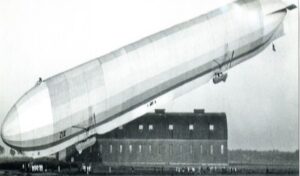
 In WW1, the Royal Navy was charged with home defence which included protecting the United Kingdom from the Zeppelin threat. With a culture of aggressive defence that perhaps would not be possible today, the Royal Naval Air Service encouraged by Winston Churchill decided to deal with the problem at source. However, they did not have aircraft with adequate range to get to the nearest Zeppelin sheds at Cologne and Dusseldorf. They were invited by Churchill to trial Sopwith Tabloids
 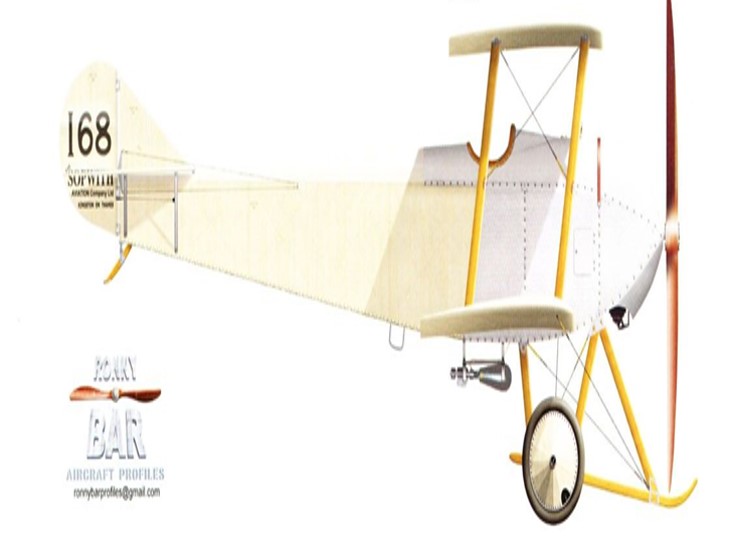 that had been rejected by the Royal Aircraft Factory as unstable. Determined to deploy the aircraft to the continent if they proved adequate, they departed at the end of their trial flight for Belgium in September 1914.
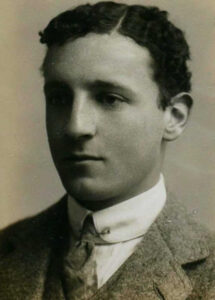 With Winston Churchill once again in the fray directly bolstering British foreign policy in the defence of Antwerp and no doubt encouraged by him, the RNAS pilots tried on 23 September to engage the Zeppelin sheds from Antwerp but were unsuccessful because of the weather. With the demise of Antwerp imminent and continual sounds of bombardment ringing in their ears on 8 October, the RNAS pilots were anxious to get going but a mist clung over the aerodrome at dawn and showed no signs of lilting. By 13.00 hours the flight commander decided they could delay no longer clambering into his Tabloid’s cockpit he took off for Cologne, followed ten minutes later by Marix heading for Dusseldorf. Each Tabloid carried extra fuel aboard as well as a pair of 20 Ib Hale bombs on primitive racks slung beneath their fuselages as speculatively shown above.
From the after action report:
‘Flight Lieutenant Manx in aeroplane No.168 was ordered to proceed to Dusseldorf. He left at 1.30 pm flying low over the trees in a westerly direction, circling the town and turning on an easterly course when north of it. On arriving at Dusseldorf he dived at the shed turning up and letting go his bombs at 600 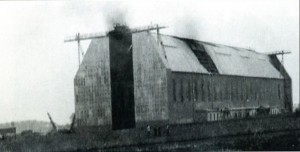 feet it was impossible to ascertain if one or both penetrated the shed but the destruction was complete. The roof fell in within 30 seconds, and flames 500 feet high were observed indicating that an inflated Zeppelin must have been inside. Lieutenant Manx was under heavy rifle and shell fire during this period and his machine suffered considerable damage. In spite of this he managed to fly back to within 20 miles of Antwerp at which point his petrol ran out. From here he succeeded in returning to Antwerp by bicycle which he borrowed from a peasant and a car which he got later. It was hoped to lake out more petrol in an armed car at daylight and recover the machine, but the order to evacuate prevented this’.
His own words describing his experiences when he eventually arrived over Dusseldorf’s new Lohausen shed are even more dramatic:
‘when I was at about 500 feet I released the two bombs one after the other, and began to pull out of my dive. I had kept my eyes fixed on the shed but 1 vividly remember the rapid points of flames as the ground machine guns opened up. I had been robbed of surprise by having to fly around looking for the shed. As I pulled out of my dive I looked over my shoulder and was rewarded with the sight of enormous sheets of flame pouring out of the shed. It was a magnificent sight’
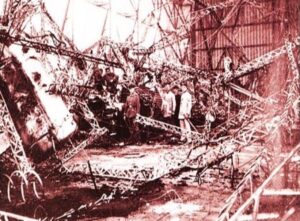 The second Hale bomb penetrated the shed and detonated as it fell, flinging red hot shards in all directions almost all of which shredded the gas cells of Army Zeppelin ZIX beneath igniting her explosive hydrogen to send a column of flame bursting through the roof. The contained blast of the explosions dislodged the sliding doors from theirrunners as the blazing skeleton of Z/X collapsed in a shower of sparks.
Marix’s return to Antwerp was also the stuff of heroes as the aircraft was very badly damaged with the rudder jammed – a significant challenge for an aircraft then solely reliant on wing warping for turning. He arrived back at Antwerp after the allied forces had withdrawn. For this action Marix was awarded the DSO. He lost a leg as a result of flying accident in 1917 but retired from the Royal Air Force as an Air Vice Marshal after WW2.
With thanks to Ray Rimell and his Windsock Datafile on the Zeppelins.