Did You Miss It? Find out What Makes the Albatros Tick
Our chat session about the Albatros is now available to watch at your leisure.
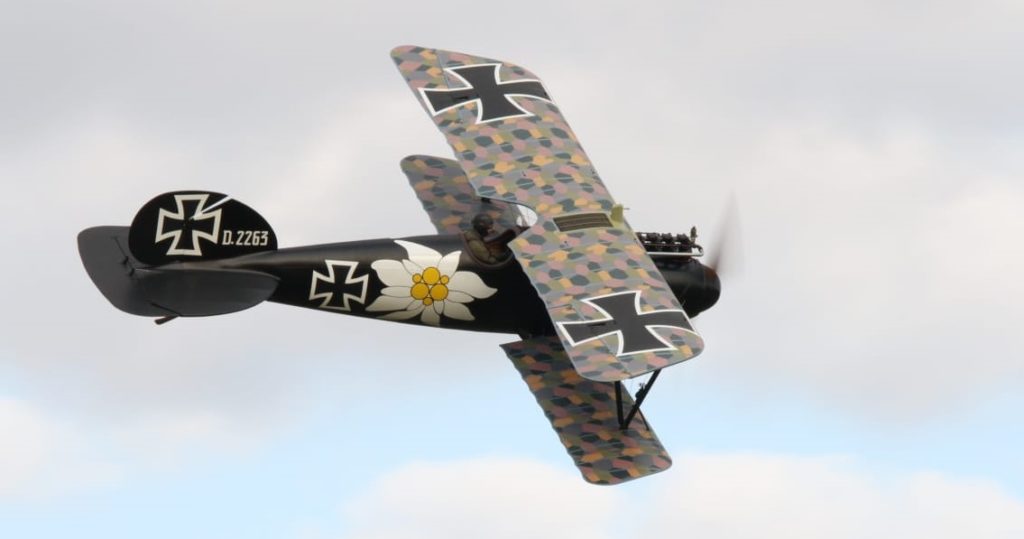
Under the Skin of the Albatros DVa – Thur 3 Feb 22 1930
The WW1 AHT will gather for their 9th chat session this time looking at the most famous Fighters to emerge from the Albatros FlugZeugWerke – the DI through to the DVa that the Trust operates. We will be joined again by Dodge Bailey from the Shuttleworth, John Lanham from TVAL and Scout Builder David Bremner. The evolution of the Albatros Fighters gives a fascinating insight into how the early German aircraft designers identified and solved problems. Few would argue that the DIII was the most successful of the type arriving at the front in late 1916 ahead of the DH2 replacements like the SE5, F2b, and Sopwith Pup. The DIII’s performance was responsible for huge allied losses in the Battle of Arras in April 1917.
Want to know more, join us on Thur 3 Feb 22 at 1930 and help us keep our aeroplanes flying.
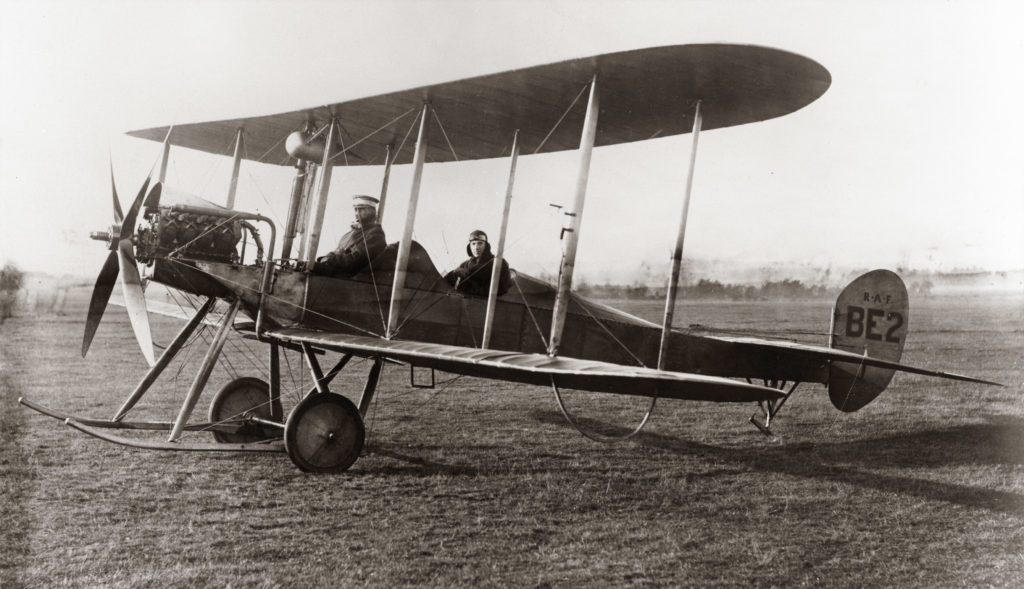
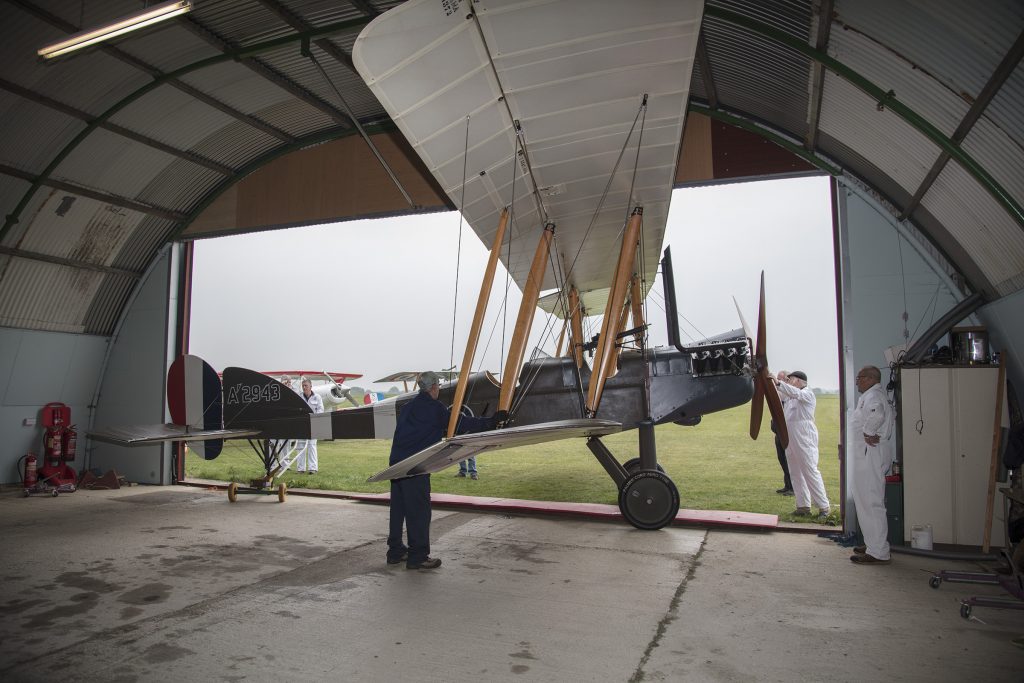
Under the Skin of the BE2
In this Chat Session on Thur 6th Jan 22 at 1930 (UK), the WW1 AHT pilots will be joined by experts on the BE2, Paul Hare and Andrew Willox, to discuss the evolution of the very early flying machines into the BE2. It was first aircraft to be designed with production and assembly in mind. Although we perhaps diminish its stately level flight speed of 55 mph and its reliance on many bracing wires for rigidity, it was way ahead of its time and more than half of the fledgling RFC element of the BEF that deployed to France on 13th August 1914 were BE2s. As well as the early history, the pilots will dissect the aeroplanes technical and operational performance.
These Chats help the Trust to keep our BE2 flying so if you would like to join us in the New Year, please click on this link.
Hear It From the Experts – As Flying Was Then and Now!
The WW1 AHT Pilots and friends met on Zoom on 2 Dec 21 to discuss the challenges of Operating 100-yr-old Aeroplanes Today. From landing grounds to runways, to the wind effect on little tail fins then and now, wing walkers, prop-swinging, no radios or brakes, all the fun of the fair. If you missed it, the recording is now available as a recording at https://ww1aviationheritagetrust.co.uk/product/operating-100-yr-old-aeroplanes-today/
Operating 100-year-old Aircraft Today
If it was easy, everyone would be doing it. On Thur 2 Dec 21 at 1930, the WW1 AHT Team lead by Jean-Michel Munn and Stu Goldspink will be discussing the challenges of operating aircraft designed when aviation was in its infancy. Many of the quirks of powered flight were learnt the hard way as the science was not always understood. Most things modern pilots take for granted were not available to the early aviators – brakes, starter motors, reliable engines, and radios as a starter for 10. We are delighted to announce that John Lanham (Chief Pilot – TVAL) and David Bremner (Bristol Scout) will be joining the Panel for this and future sessions.
If you would like to join us and help keep our aeroplanes flying, please follow the link.
Excellent! Interesting! Top Stuff!
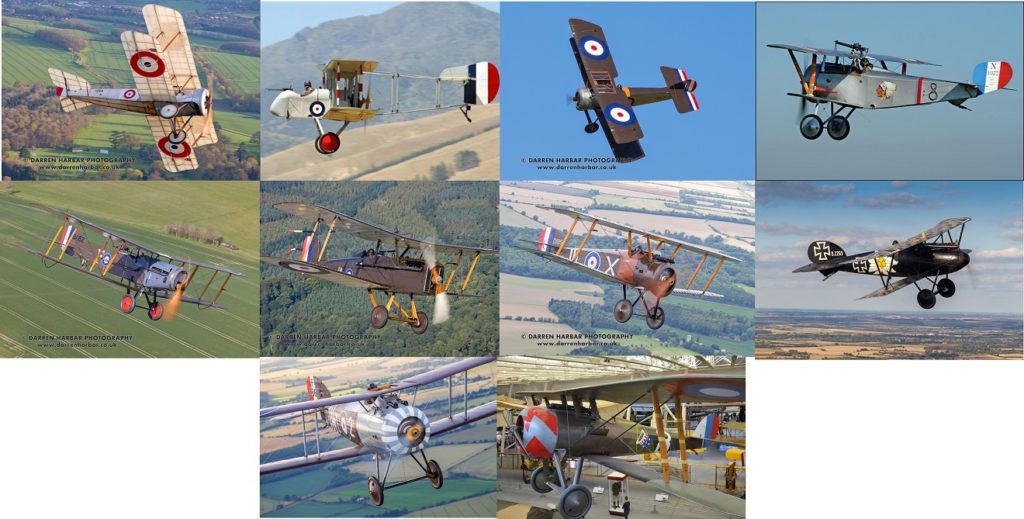
Yesterday (Thur 4th Nov at 7.30 pm [UK]), the pilots of the WW1 Aviation Heritage Trust chatted about their experiences flying WW1 aeroplanes. The title reflects the feedback that we received. We were joined by David Bremner who built and flies a reproduction of his grandfather’s Bristol Scout and John Lanham who is the Chief Pilot at the Vintage Aviator in Wellington NZ. Between them, the pilots had flown all the aeroplanes under discussion – Bristol Scout, DH2, Sopwith Pup, Nieuport 17, Bristol Fighter, SE5a, Sopwith Camel, Albatros Dva, Sopwith Snipe, Nieuport 28. Our thanks to Darren Harbar and Allan Udy of HAFU for providing lots of great video.
If you missed it, you can listen to the pilots’ pearls of wisdom by clicking this link.
4 Hours to go – Thur 4th Nov 7.30pm. WW1 Fighters Compared
On Thur 4th Nov at 1930 on Zoom, the WW1 AHT Pilots led by Jean-Michel Munn and Stu Goldspink assisted by David Bremner will talk about the different WW1 Fighter that they have flown. This will be the first in the new programme of chat sessions that the Trust will run monthly for the winter months on the last Thursday of each month after the first one. Get the dates in your diaries. The Full programme can be found here. While the chats are fascinating in their own right, you will be contributing to the Trust’s continuing efforts to keep their WW1 aeroplanes flying.
In this session, they will discuss the Bristol Scout, DH2, Sopwith Pup, Nieuport 17, Bristol Fighter, SE5a, Sopwith Camel, Albatros Dva, Sopwith Snipe, Nieuport 28.
If ever an aeroplane owed its place in history to the men who flew it, then that aeroplane was the Nieuport 28. Surely one of the most elegant-looking warplanes of the war, the Nieuport 28 was enjoyable to fly but was far from outstanding in the performance stakes and plagued by serious design problems. Passed over by the French, it became the first operational fighter to equip the American Expeditionary Force in 1918 mainly because there was a shortage of SPAD XIII fighters at the time. Its wing fabric-shredding tendencies and volatile Gnome-Monosoupape engine notwithstanding, the Type 28 was generally well-liked by its American pilots; several of them, such as Eddie Rickenbacker and Douglas Campbell, scored a number of victories flying these aeroplanes.
WW1 AHT Albatros and BE2 Display at Last
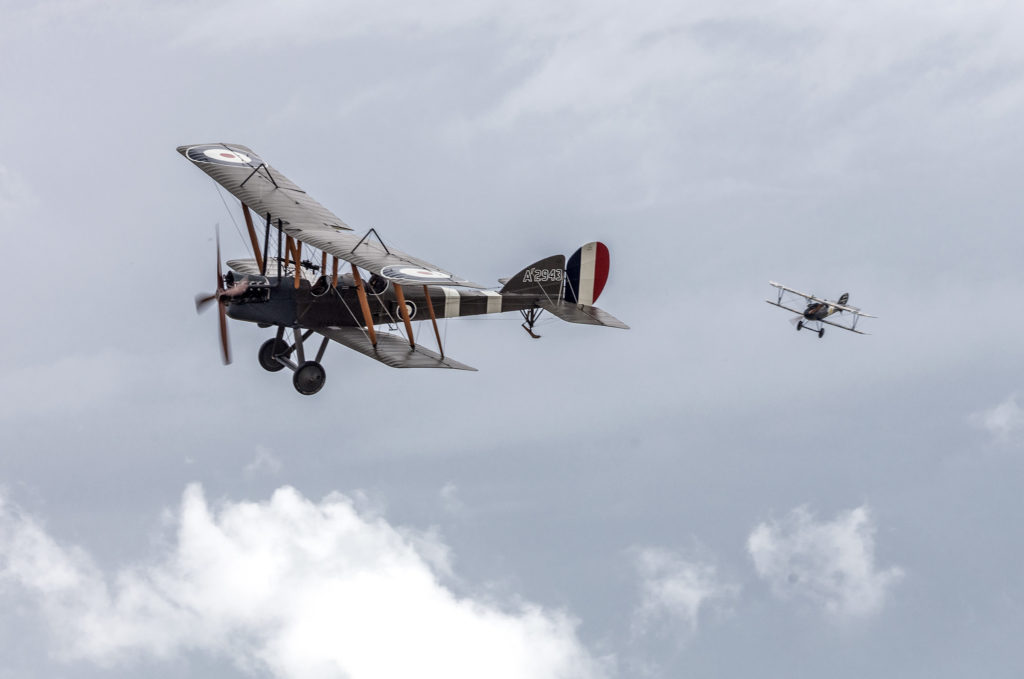
With rain and thunderstorms threatening, it was a great relief for the weather at Stow Maries to be warm and the wind light, albeit increasingly easterly across the runway in the afternoon last Sunday 25th July. It was also a great pleasure to have the BE2 and the Albatros serviceable and ready to go for which our thanks go to the Culture Recovery Fund and the DCMS for making it all possible. The top picture captures graphically how even more poorly placed the BE2s were when the Albatros appeared having suffered harshly with the Eindeckers. Something the crews had to endure till the summer of 1917 when eventually the RE8s started replacing the BE2. Bravely flown on Sunday by Jonathan Marten-Hale, there was little he could do prevent Jean-Michel Munn the Albatros acquiring firing positions at will. Is is a great shame that David Bremner could not join the fray in the Bristol Scout because of the crosswind especially as his team came from far and wide to be in Essex for the weekend. At least, he had the consolation of a flight in the morning. My thanks to the WW1 AHT team, Terry Dann as FDD, and all the Stow volunteers for making it all happen. DF

Pilot Chat Sessions – Rain Check
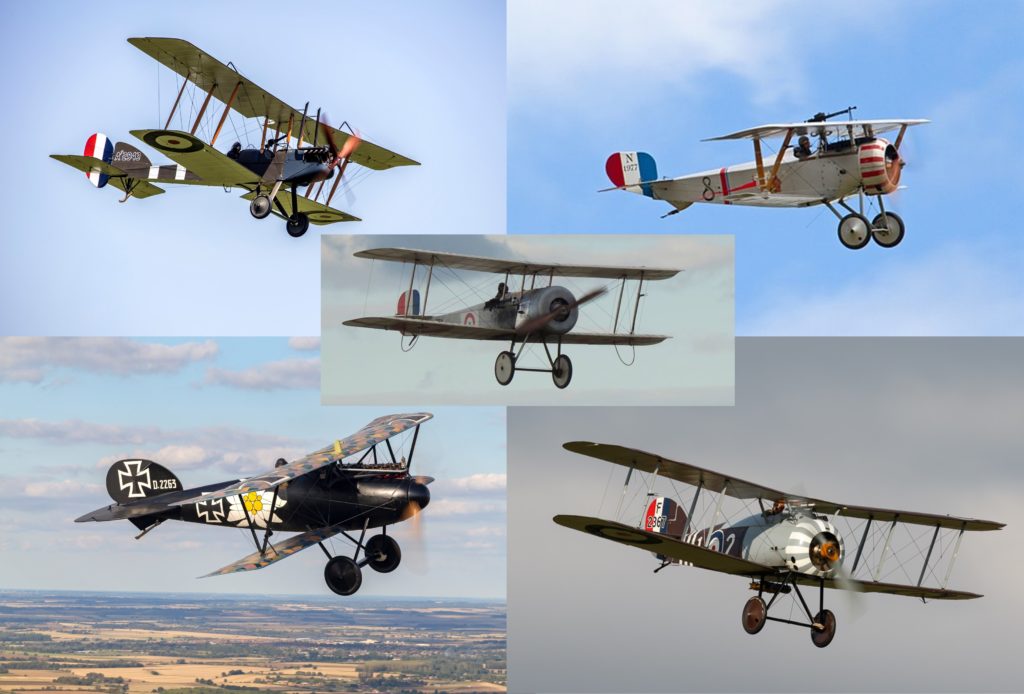
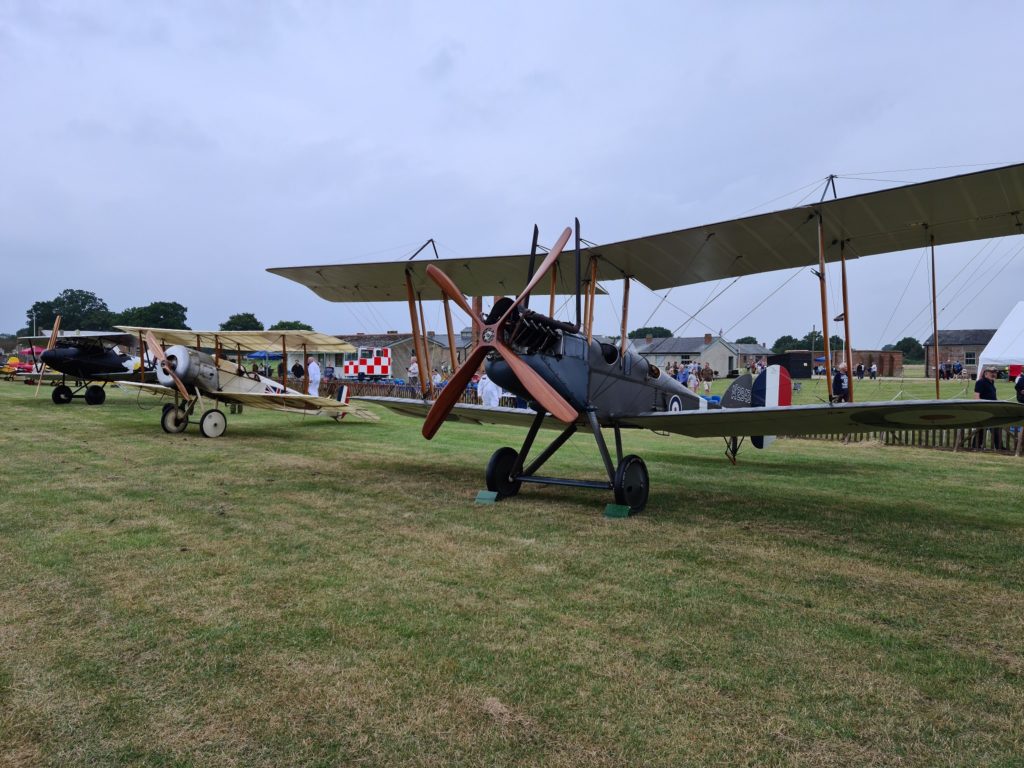
In the last 5 months, the WW1 Aviation Heritage Trust pilots have given 5 Pilot Chat sessions about their experiences flying the Trust aircraft that you see above. The Bristol Scout built, owned, and flown by David Bremner joined us for the last session about our return to Northern France for the Centenary Commemoration of the Battle of the Somme on 1 July 2016. We think that with the end of the lockdown in sight that you all need a break from Zoom and propose to start again in September as the nights draw in. The remaining programme can be found here.
The break gives an opportunity to aim and adjust. It would be great if you could conduct our short survey to see how we might improve the sessions. If you missed the chance to see these fascinating insights into flying these old machines, they are available pay per view £5 Plus VAT through links on the Programme page .
WW1 AHT Albatros Check Flight 7 May 2021
Jean-Michel Munn carrying out the check flight on our Albatros DVa at Stow Maries taken from a selection of Go Pros. He has trimmed it to 3.5 minutes and provided some text to explain what he is doing. It is a fascinating insight into flying a WW1 aeroplane. Our thanks to the Stow Maries volunteers for doing their ground handling training at the same time and a huge thank you to the Culture Recovery Fund for making it all possible.